In 2012, as I was starting my first semester of college, the American Society for Reproductive Medicine officially removed the “experimental” label from egg freezing. I had no idea at the time, but that single medical milestone would shape the trajectory of my life.
Why I Started Thinking About Egg Freezing
Over the next few years, the cultural narrative around fertility started to transform—and I was shifting right alongside it. When I graduated in 2016 and moved to New York City to work as a freelance journalist, many of my liberal arts classmates took jobs at big tech companies that had started covering elective egg freezing as an employee benefit. At around that same time, a wave of reproductive health startups started mainstreaming advancements in fertility care as a way to empower women to build our lives on our own terms and timelines.
I was offered a role as a content writer at one of those startups. Suddenly, I was hearing words like “doula” and “in vitro fertilization” for the first time. The more I was exposed to it, the more I realized that we really don’t learn about (or get encouraged to start planning for) what can “go wrong” in family-building until we’re actively living through those hurdles – and desperately looking for a way out.
When we’ve spent years trying to conceive but it isn’t working, or we’ve run out of insurance coverage for another IVF cycle, or we suddenly feel up against our biological clock but aren’t ready for parenthood just yet.
I spent the next few years trying to combat that through content. I interviewed industry leaders, doctors, entrepreneurs and activists on a self-imposed mission to demystify reproductive health. We covered every “out of reach” subject I could think of: trying to conceive, breastfeeding, childbirth, endocrine disruptors, postpartum recovery, pleasure, infertility. No question was off limits, and no newly obtained fact was withheld from conversation over dinner with my friends. They still haven’t forgiven me for demonstrating an episiotomy tear on a paper napkin.
This work eventually landed me at a fertility clinic, interviewing a reproductive endocrinologist during my own initial fertility consultation. The goal of the appointment? To learn the status of my fertility.
Instead, I learned that there is no magic test—besides trying to conceive—to know your future family-building potential. There are only options, like egg freezing, that may help preserve some possibility for later.
The Part of Egg Freezing I Couldn’t Afford to Ignore
Right around this time came the post-2020 boom in fertility care, as people sought proactive ways to feel more educated about and in control of their healthcare options. The pandemic delayed dating timelines, remote work offered unprecedented scheduling flexibility, and social media fueled awareness as people became more and more willing to share their stories on their platforms. Demand for egg freezing skyrocketed.
It only took a week after my own consultation to realize I wanted to be part of this rapidly growing space. I joined the marketing team of that very clinic, where I spent four years talking to women across every possible channel about their family-building options, learning right alongside them each step of the way.
But behind the scenes, I was holding two conflicting truths. I knew I didn’t want a baby anytime soon, but I desperately hoped it would be easy to get pregnant when I was ready. And while I was encouraging other women to pursue egg freezing and make the most of the options available to them, I was actively not making that choice for myself – simply because it felt financially inaccessible to me.
The glaring “catch” amidst the egg-freezing boom, and one that often gets swept under the rug, is access. I was lucky enough to live in a city with some of the best fertility care in the world, and to call some of the city’s best doctors my colleagues… but I still couldn’t easily afford it. So, I leaned on the comfort of “having time” to delay my decision.
Until suddenly I didn’t.
When My Timeline Suddenly Changed
I ended a long-term relationship right as I was about to turn 30, and instead of grieving the loss of that person, I found myself grieving the loss of the timeline I had expected my life to follow (married by 32, first baby by 34, second baby by 36 before age-related fertility issues would likely start surfacing). For the first time in my life, the noise of my biological clock was really loud… and for the first time, I resented that I knew as much as I did.
Serendipitously, my company announced a new benefits policy that same week – one that fully covered elective egg freezing. Trusting my gut and “life’s timing,” I scheduled my cycle.
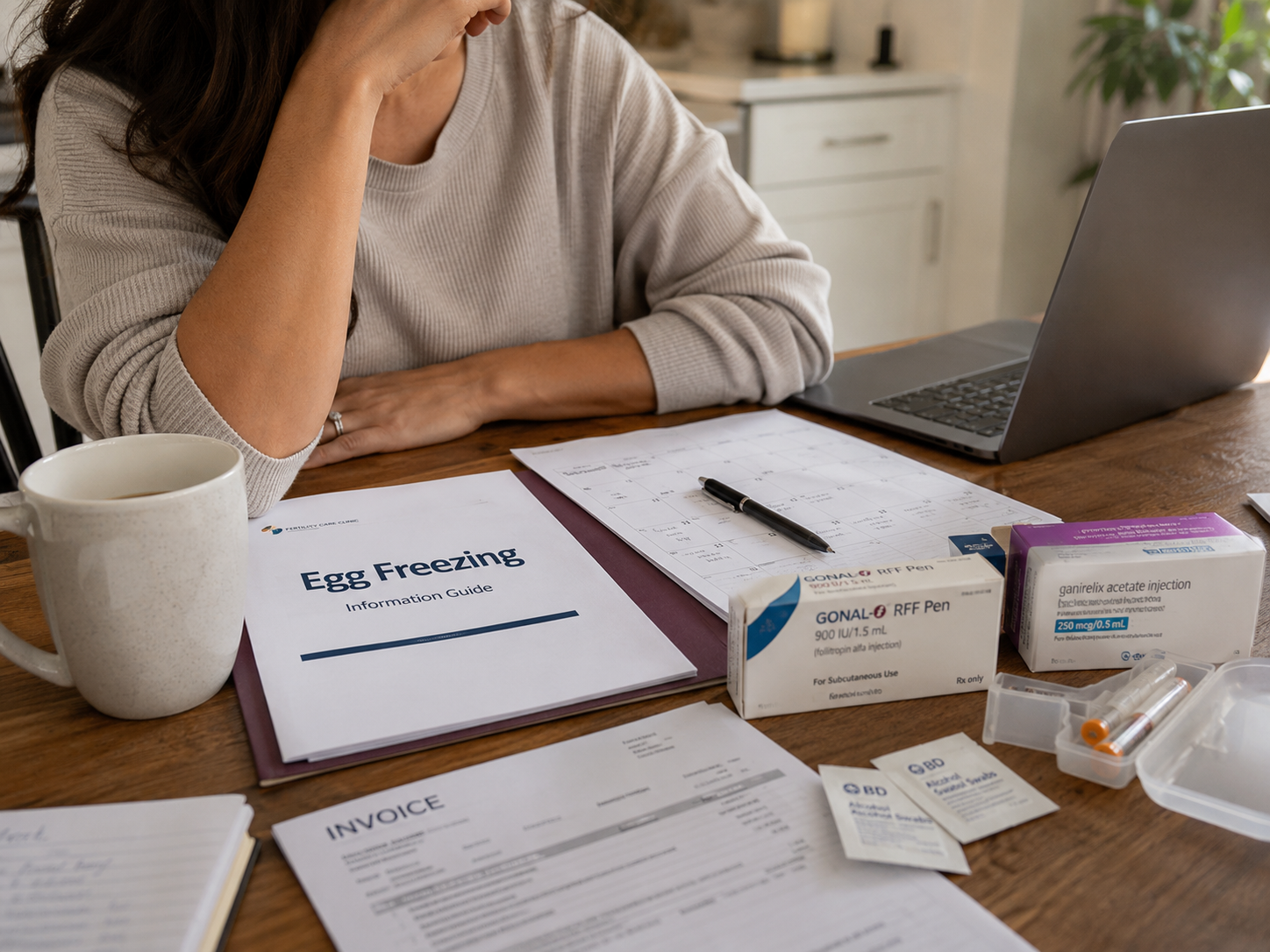
I had spent years talking about this procedure. I understood the process. I knew the language. I knew the shots, the appointments, the monitoring, the retrieval. I knew egg freezing was not a guarantee. At least, I thought I did.
What No One Told Me About Egg Freezing Results
Then came the part that, even with all my professional knowledge, I never considered could happen to me as a patient: I didn’t get as many eggs as I thought I would. Egg freezing is not a guarantee. While you can go into it knowing your ovarian reserve, you won’t know how your body is going to respond to stimulation until you’re actively in the process. For me, some follicles are released early. Some eggs never reached maturity. I ended up with about half as many frozen eggs as I initially expected. It was still a good number for my age, but as a Type A perfectionist… it took a while to not feel like my body had failed me or like I must have messed something up during that two week period of time.
Had I done something wrong? Had I moved too much? Not rested enough? Eaten the wrong thing? Missed some invisible cue from my body? Of course, that’s not how it works. But when you are the person whose body just produced fewer eggs than you expected, logic doesn’t always get to be the loudest voice in the room.
Even so, I am incredibly grateful I froze my eggs. For the past two years, I’ve felt able to move at my own pace and make decisions based on what feels right, not what feels urgent. My relationship, my career, my friendships, my personal passions and my overall love of life have all benefited deeply from the privileged choice I was able to make. But I’ve learned that gratitude and uncertainty can exist at the same time.
The Question I’m Still Asking Myself
After my egg freezing cycle, my doctor told me to check in when I turned 32 to evaluate if I should do another cycle based on my results. I turn 32 next week, and my biological clock, though quieter this time, is ticking again.
Do I bank on the unproven theory that my body will be able to get pregnant when I start trying to have kids later into my 30s? Do I trust that my 30-year-old frozen eggs will be “good enough” to create embryos and get me to my family-building goals if it turns out I do end up needing IVF down the road? Is it “worth it” to dip into my savings for another round of egg freezing, or wait and see and invest that money in a different goal of mine? It’s a tradeoff women shouldn’t have to make.
If we are going to market egg freezing as an “ultimate tool for female empowerment,” we owe women financial clarity before the first injection is ever drawn. Because at the end of the day, egg freezing is a roll of the dice. We are asking women to place a massive financial bet on their biology, often with incomplete information and zero guarantees. When a cycle yields fewer eggs than expected, the burden (both emotional and financial) falls entirely on the patient’s shoulders.
For egg freezing to continue to advance, we need financial models that actually share the risk with patients and acknowledge the uncertainties. After everything I’ve witnessed professionally (and experienced personally), I found myself wanting to help build something that addressed the very fears and tradeoffs so many women had described to me for years. That led me to co-create a program for egg freezers centered around everything I wish we’d had going through the process ourselves: more transparency, more support, and more financial protection against the unpredictability of biology.
When women freeze their eggs, they are making a profound investment in their futures, and gambling on a procedure they may not truly know the success of for years down the line, when they’re leaning on those eggs as their “last resort.” It’s time that not only their employers, but the fertility industry itself, invests in them in return. Because while the end goal of fertility care is bringing home a baby, it’s also about having a choice. And a choice is only real if you have the support to actually make it.
FAQ
Is egg freezing a guarantee?
No. Egg freezing may preserve the possibility of using younger eggs later, but it does not guarantee a future pregnancy or baby. The number of eggs retrieved, how many are mature enough to freeze, how they thaw and whether they eventually lead to embryos or pregnancy can all vary. It can be a powerful option, but it is still not a promise.
What is one thing women should know before freezing their eggs?
One of the biggest things to understand is that the number of eggs retrieved can vary, even when you go into the process with testing, information and a plan. A cycle may not produce the number someone hoped for or expected, and that can be emotionally difficult—especially after investing so much time, money and hope into the process.
Why can egg freezing feel emotionally complicated?
Egg freezing can feel emotionally complicated because it asks women to make expensive, deeply personal decisions about a future they cannot fully predict. It can offer a sense of relief and possibility, but it can also bring up pressure, uncertainty and grief around timing, relationships, money and the life someone imagined they would have by now.