
There are a lot of baby products designed to make parenting easier that somehow require you to learn a 14-step folding mechanism, buy six separate adapters and dedicate half your trunk to making them work.
The original Doona became so popular because it did essentially the opposite.
It took two things parents were already schlepping around—a car seat and a stroller—and turned them into one. You take the car seat out of the vehicle, release the built-in wheels and suddenly you’re pushing a stroller instead of carrying a 15-pound car seat with a baby inside it.
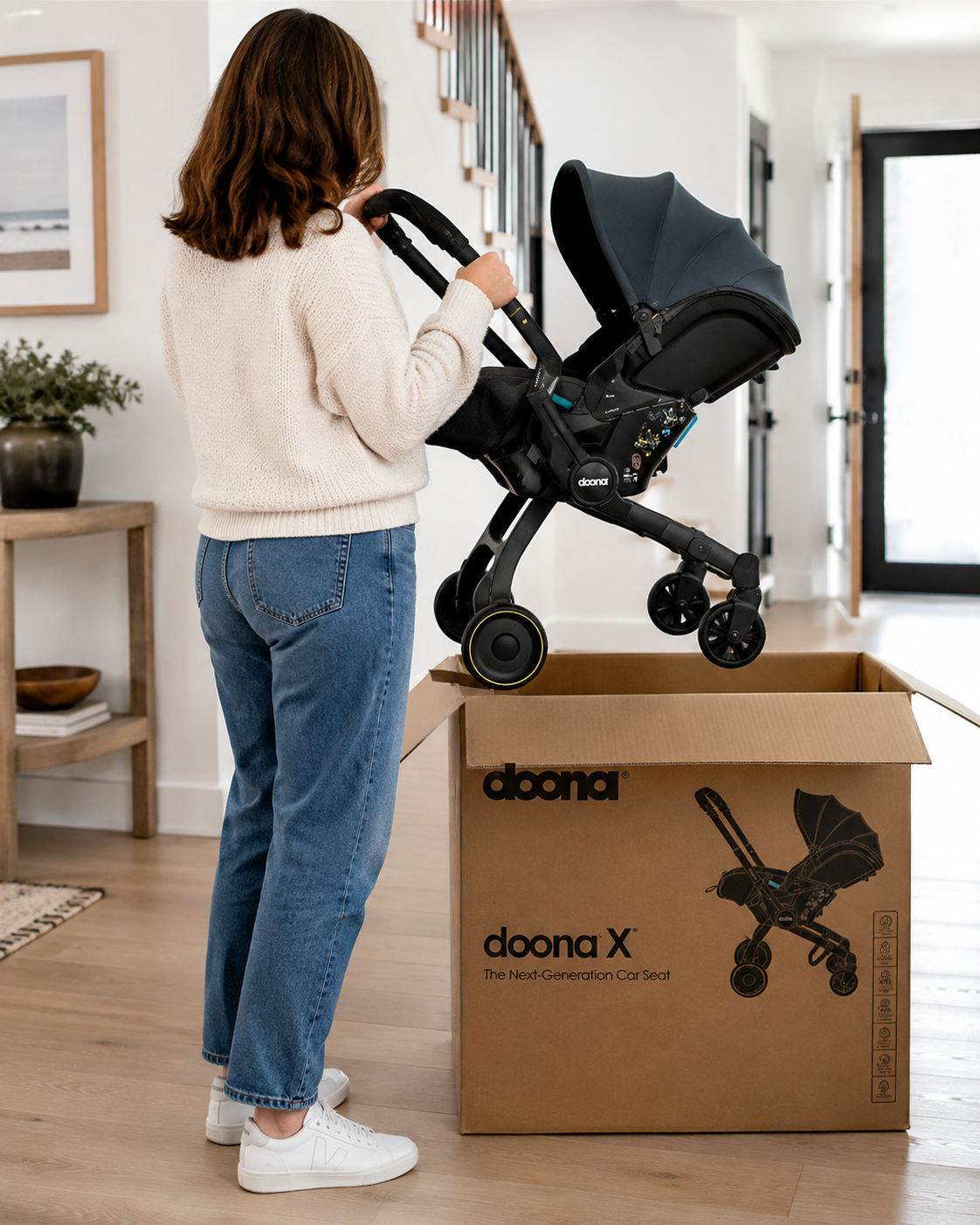
The newly released Doona X Car Seat & Stroller takes that same basic idea and gives it a pretty substantial update. The new model reclines in stroller mode, has an adjustable handlebar, an easier-to-adjust harness and headrest, upgraded suspension and a redesigned LATCH base. It also costs $850, which puts it firmly in the I need to know if this is actually worth it category.
So I tested the Doona X with one question in mind: Do these upgrades meaningfully make life with a baby easier—or is the original Doona still enough?
Here’s what I found.
The Quick Answer: Is the Doona X Worth It?
The Doona X makes the most sense for parents who are constantly getting a baby in and out of the car, travel frequently or want to eliminate the need to transport a separate stroller during the infant stage. The biggest upgrade over the original Doona is the ability to recline the seat in stroller mode, followed closely by the adjustable handle, easier harness adjustment and updated base.
The trade-offs are significant, though. At 19.6 pounds without a baby, the Doona X is heavy for an infant car seat. It also costs $850, doesn’t have a traditional built-in stroller basket and can only be used until your baby reaches the seat’s height or weight limit.
My verdict: I can absolutely see why parents love the Doona X, but I also think where you live—and how you move through your day—matters a lot. For me, living in the suburbs and regularly pushing a stroller over centuries-old Massachusetts sidewalks and uneven roads, it isn’t the stroller I’d reach for for long neighborhood walks. But if I were raising babies in New York City, where I lived for 10 years, this thing would have come in clutch. Being able to go from car seat to stroller in seconds for taxis, Ubers, restaurants, airports, quick errands and tight city spaces solves a very real parenting headache. It’s an incredibly smart product; I just don’t think every family needs it in quite the same way.
What Is the Doona X?
The Doona X is a rear-facing infant car seat with stroller wheels built directly into the seat. Instead of clicking your infant car seat onto a separate stroller frame, you remove the Doona X from the car and deploy its wheels to turn the entire thing into a stroller.
It has three basic modes: car seat, pull-along and stroller. In stroller mode, the X now offers three recline positions—Sit, Relax and Lean Back—with the deepest recline reaching up to 159 degrees. It cannot be reclined while being used as a car seat.
The Doona X currently costs $850, and that price includes the Doona X, its LATCH base, infant insert and vehicle seat protector.
Doona X Specs
- Price: $850
- Product weight: 19.6 pounds
- Baby weight limit: Up to 30 pounds
- Baby height range: 17 to 32 inches
- Recline: Three positions in stroller mode, up to 159 degrees
- Harness: Integrated 5-point, no-rethread harness
- Handlebar: Two adjustable height positions
- Car seat position: Rear-facing only
- Included: LATCH base, infant insert and vehicle seat protector
- FAA approved: Yes
How I Tested the Doona X
I tested the Doona X the way I would actually use it as a mom of three living in the suburbs—not on a perfectly smooth showroom floor. I took it in and out of the car, converted it between car seat and stroller mode, pushed it around town and paid close attention to the things that matter when you’re doing all of this with a baby in tow: how quickly it transitions, how heavy it feels to lift, how easy it is to maneuver and whether the new features actually make everyday life easier.
I also tested it on the kind of terrain I encounter all the time where I live in Massachusetts, which means plenty of uneven sidewalks, cracks and very old, very bumpy roads. That turned out to be an important part of my experience with it. The Doona X is incredibly convenient for quick transitions and errands, but it isn’t an all-terrain stroller—and on rough suburban streets, you can feel that difference.
I kept coming back to one question throughout testing: Does the convenience of having your infant car seat instantly become your stroller outweigh the compromises that come with such a compact design? For some families, I think the answer is very clearly yes. For others, including mine, it’s a little more nuanced.
I specifically paid attention to how easy it was to get in and out of the car, how intuitive the car-seat-to-stroller conversion felt, how smoothly it pushed on different surfaces, how comfortable the recline appeared to be, how much the weight bothered me when lifting it and whether I missed having traditional stroller storage.
One moment that really sold me on the concept was a quick errand where I would normally have had to choose between lugging the infant car seat inside or pulling a separate stroller out of the trunk for a stop that was going to take 15 minutes. With the Doona X, I just got out, popped the wheels down and kept moving. That’s the kind of tiny parenting inconvenience you don’t realize is draining until a product suddenly removes it.
The Recline Is the Upgrade I Immediately Understand
The biggest change between the original Doona and the Doona X is also the one that makes the new model considerably more stroller-like.
The original Doona essentially stays in its car-seat position even when you’re strolling. The X gives you Sit, Relax and Lean Back positions, with the deepest recline reaching up to 159 degrees. And this matters more than it might sound on paper.
A stroller isn’t only transportation. It’s where babies inevitably fall asleep while you’re trying to finish lunch, walk through an airport, make one more stop or simply get out of the house. Being able to change their position once you’re safely in stroller mode makes the Doona X feel less like an infant car seat that happens to have wheels and more like an actual stroller.
The recline was surprisingly easy to operate once I knew where the lever was, and I liked that I could change the position without turning it into a whole production while I was out by myself. The stroller still felt sturdy in the more reclined positions, and the near-flat option makes the X feel much more like an actual stroller than the original Doona did. I wouldn’t say the upgraded suspension magically turns it into a full-size stroller—especially on the bumpy Massachusetts roads where I tested it—but the recline itself is one of those upgrades that feels genuinely useful rather than something added just to justify a new model.
One important distinction: the recline is for stroller mode only. The Doona X cannot be reclined while installed or used as a car seat.
Getting From Car Seat to Stroller Really Is the Whole Point
The reason people become borderline evangelical about the Doona has never been because it has the biggest canopy or fanciest handle.
It’s because it removes a step—and during the baby stage, removing one annoying step from something you do several times a day can feel disproportionately life-changing.
There’s no stroller frame to pull out of the trunk, no adapter to line up, no waking a sleeping baby so you can transfer them. The wheels are already attached to the car seat.
The first time I converted it, I definitely had a brief wait, what am I pressing again? moment—there are a couple of motions you have to get in the right order, and I wouldn’t call the very first attempt completely instinctive, but after doing it a few times, it clicked surprisingly fast, and soon I could pop the wheels out and get moving without really thinking about it. That’s where I started to understand the Doona appeal: once the mechanism becomes muscle memory, getting from the car to wherever you’re going feels almost ridiculously easy.
That convenience is especially easy to appreciate for quick errands. Going into a coffee shop or pediatrician’s office for 20 minutes normally presents the weird newborn-parent choice between carrying the infant seat—which gets very heavy very quickly—or hauling out the stroller for a very short trip.
The Doona essentially eliminates the decision.
The New Handlebar Is a Small Change That Makes a Big Difference
The Doona X adds a two-position adjustable handlebar, while the original Doona has a single handle height. The new handle also has a faux-leather grip.
At 5’4″, I found the lower handle position comfortable and easy to maneuver without feeling like I was reaching up or pushing at an awkward angle. My husband Dan is 6’1″, and the higher setting made a noticeable difference for him—he could stand more naturally instead of hunching over the stroller. Neither of us found ourselves constantly kicking the back of it while walking, which sounds like a small thing but is exactly the kind of detail that can make or break how pleasant a compact stroller feels in real life.
This is one of those specifications that doesn’t look particularly exciting on a product page but can make a big difference when you are actually pushing a stroller around for an hour.
The Harness Is Much Less Annoying to Adjust
Another worthwhile upgrade: the Doona X uses an integrated headrest and harness system, so the height adjusts without having to manually rethread the straps as your baby grows.
Doona also added self-fastening shoulder pads that attach against the headrest when you’re putting your baby into the seat.
Neither sounds revolutionary until you remember that most baby gear annoyances are extremely tiny inconveniences repeated approximately 700 times.
The straps were easy to tighten and, importantly, didn’t turn into that annoying twisted mess that can make buckling a baby in feel harder than it should. I also liked the self-fastening shoulder pads more than I expected to—they stay out of the way while you’re getting your baby situated instead of constantly sliding underneath them. Are they the reason I’d buy the Doona X? No. But they’re one of those thoughtful little upgrades that makes repeated everyday use feel noticeably smoother.
How Does the Doona X Push?
The X adds a shock-absorbing mechanism intended to create a smoother ride, along with a softer wheel-release system when switching from car-seat to stroller mode.
I tested it on the very old, very uneven streets and sidewalks around my Massachusetts suburb, which is admittedly a pretty unforgiving test for any compact stroller. On smoother stretches, the Doona X was easy to steer and maneuver, and for popping into a store, crossing a parking lot or getting from the car to wherever we were going, it was great. But once I hit cracked sidewalks and the centuries-old bumpy roads that are basically a fact of life here, I could definitely feel the limitations of the smaller wheels.
That doesn’t feel like a flaw so much as an important distinction in what the Doona X is designed to do. This isn’t the stroller I’d choose for a long, leisurely walk over rough New England terrain. It’s the stroller I’d want when the goal is getting from point A to point B with as little baby-gear wrangling as possible—and on smoother city sidewalks, inside stores, airports or quick errands, that’s exactly where I think it shines.
My biggest takeaway was that the Doona X is at its best when convenience matters more than terrain. On smooth surfaces, it feels nimble and incredibly easy to maneuver, but the smaller wheels aren’t going to disguise every crack, brick or ancient Massachusetts pothole. For quick errands, parking lots, stores, airports or city sidewalks, though, that trade-off makes a lot of sense—because what you’re gaining is the ability to go from car seat to stroller in seconds.
I would specifically say this is great for smooth sidewalks, store floors, parking lots and quick in-and-out errands, but not ideal for the cracked sidewalks and uneven old roads around my Massachusetts suburb because the compact wheels simply don’t absorb rough terrain the way a larger, more traditional stroller does.
This matters because the Doona X is still a compact travel system rather than a big-wheeled all-terrain stroller. Parents who regularly walk miles over uneven sidewalks, trails or rough terrain may still want a traditional stroller designed for that purpose.
The Biggest Downside: It’s Heavy
Here’s the part that would give me pause before automatically telling everyone to buy it.
The Doona X itself weighs 19.6 pounds before you put a baby in it.
That number matters because there will still be moments when you need to physically lift the whole thing—into an SUV, up stairs, onto a plane or simply into the car.
At 19.6 pounds before you even add a baby, this is not a lightweight infant car seat—and I noticed that most when lifting it in and out of the car. I could absolutely manage it, but it’s the kind of weight you feel, especially if you’re reaching into a higher SUV or carrying it more than a few feet. The upside is that you’re rarely carrying it for long, since the whole point is that you can deploy the wheels almost immediately; for me, that made the extra heft much easier to forgive.
If most of your day involves rolling the Doona directly from sidewalk to car, the weight may be an easy trade-off for the convenience.
If you live in a walk-up, have physical limitations, regularly need to carry your infant seat long distances or drive a tall vehicle, I’d pay very close attention to the weight before buying.
I Still Wish It Had More Built-In Storage
Traditional stroller people, prepare yourselves.
The Doona X still doesn’t suddenly give you the giant undercarriage basket where you can throw a diaper bag, three water bottles, a sweatshirt, a package you forgot to return and somehow an entire scooter.
Doona now sells X-specific storage accessories, including a $75 Storage Basket and $130 Pack & Go Basket, but those are additional purchases on top of an already expensive travel system.
For a quick errand, I can forgive limited storage much more easily. For an all-day outing, I’d notice it.
Doona X vs. Original Doona: What’s Actually Different?
If you already know the original Doona, this is probably the question you’re really asking.
The basic concept hasn’t changed: both products transform from an infant car seat into a stroller and both are FAA approved.
The X adds several meaningful upgrades:
- Three stroller recline positions
- Integrated no-rethread harness and adjustable headrest
- Two-position adjustable handlebar
- Extended canopy
- Self-fastening shoulder pads
- Shock absorption
- Smoother wheel deployment
- X-specific storage options
- Redesigned included LATCH base
- Certification under the newer FMVSS 213B standard
The X also costs substantially more.
That means the decision isn’t really whether the Doona X is better. On features, it clearly is.
The question is whether the features that are better are worth the additional money for the way your family will use it.
Who I Think the Doona X Is Best For
After using it, I think the Doona X makes the most sense for:
Parents constantly getting in and out of the car. This is where the Doona concept is hardest to beat. Daycare drop-off, pediatrician appointments, coffee runs and quick errands require dramatically less stroller logistics.
Families who travel frequently. Having one piece of gear perform the job of both infant car seat and stroller can simplify airports, rental cars, taxis and rideshares. Both Doona models are FAA approved.
Parents who wanted the Doona but hated the fixed stroller position. The new recline is probably the single most compelling reason to choose the X.
Taller parents. The adjustable handle gives the X an advantage over the fixed-height original.
Parents buying their first Doona. If the price works for your budget and you know you’ll use it constantly, I think the upgrades are significant enough that I would strongly consider the X rather than immediately defaulting to the older model.
Who Might Want to Skip It
I would think twice if:
You want an all-terrain stroller. A compact car-seat/stroller hybrid and a large-wheeled traditional stroller solve different problems.
You need tons of storage. You’ll likely need accessories.
You don’t drive much or frequently transition in and out of a car. You’re paying a premium for the exact feature you may not use very often.
You want baby gear to last for years. The Doona X is an infant car seat, not a stroller your child will ride in through preschool. It’s approved for babies up to 30 pounds and 32 inches.
Lifting a heavy infant seat is difficult for you. At 19.6 pounds before adding your baby, this is absolutely something I’d consider before purchasing.
Doona X FAQ
How much does the Doona X cost?
The Doona X costs $850 and includes the Doona X car seat/stroller, LATCH base, infant insert and vehicle seat protector.
Does the Doona X recline?
Yes. In stroller mode, the Doona X has three positions—Sit, Relax and Lean Back—with a maximum recline of 159 degrees. It does not recline while being used as a car seat.
What’s the difference between the Doona and Doona X?
The Doona X adds three recline positions, an adjustable handlebar, integrated no-rethread harness and headrest, upgraded canopy, shock absorption, smoother wheel deployment and an updated LATCH base, among other improvements.
How much does the Doona X weigh?
The Doona X weighs 19.6 pounds without a baby.
What are the Doona X height and weight limits?
The Doona X is designed for infants from 17 to 32 inches tall and up to 30 pounds.
Is the Doona X FAA approved?
Yes. Doona says both the Doona X and original Doona are FAA approved for aircraft travel.
Can you use the Doona X without the base?
Yes. The Doona X can be installed in a vehicle without its LATCH base using the vehicle’s seat belt, which makes it particularly useful for taxis, rideshares, rental cars and travel. Doona specifically supports baseless installation, though you should always follow the Doona X user guide and your vehicle’s instructions to make sure the seat is installed at the correct angle and securely.
Can the Doona X replace a regular stroller?
For some families during the infant stage, possibly. But parents who want substantial storage, larger wheels, all-terrain capability or a stroller that lasts well beyond the infant car-seat stage may still want a traditional stroller as well.
Is the Doona X better than the original Doona?
The Doona X has substantially more features, particularly the stroller recline, adjustable handlebar and no-rethread harness. Whether those upgrades make it better for your family depends on how frequently you’ll use them—and whether the $850 price fits your budget.
Editor’s note: The Mother Chapter received the Doona X as a gifted product for editorial consideration. This article was not sponsored or paid for, and the brand did not review or approve the content. All opinions are our own.
Prices and availability were accurate at the time of publication and may change.