When I was just nine years old, I was diagnosed with Ulcerative Colitis (“UC”), a chronic inflammatory bowel disease in which abnormal immune responses cause inflammation and ulcers along the inner lining of the large intestine. After years of failed treatments, I ultimately had no choice but to undergo a series of major surgeries during my freshman year of college which removed my entire colon and created a man-made internal organ known as a J-Pouch.
From the very beginning, complications followed. My J-Pouch never functioned properly, and I was never able to reach remission. As I navigated the daily realities of living without a colon, one question haunted me quietly through my teenage years and into early adulthood: Would I ever be able to have my own biological child?
Many doctors reassured me that pregnancy would be possible—high-risk, yes, but not impossible. But as the years passed and my J-Pouch issues worsened, it became painfully clear that carrying a pregnancy simply wasn’t in the cards for me.
That reality became unavoidable when a world-renowned specialist discovered I was experiencing something called a pouch prolapse—essentially, the surgical wall of my J-Pouch was collapsing. My very first question was whether pregnancy was still possible. His answer was devastating: carrying a pregnancy could put me at extreme risk of losing my J-Pouch entirely, and it could not be replaced.
At that moment, the decision was made. I could never even attempt to carry a pregnancy. The thought of risking my health—or worse, resenting my own child for the loss of my J-Pouch—was unimaginable.
Choosing Surrogacy When You’re Not Infertile
Unlike many people who turn to surrogacy, I was not infertile. My body simply could not safely sustain a pregnancy. I never felt broken or like I had failed as a woman. After everything I had endured—surgeries, hospital stays, endless procedures—there was no part of me that wished I could carry a pregnancy.
Yet, that distinction was rarely understood—or respected. When surrogacy came up, the most common response I heard was, “Why don’t you just adopt?” It was almost always asked casually, as if the question itself were neutral. I often wanted to answer honestly: Why didn’t you just adopt? Oh—because you wanted a biological child. Right. So did I.
The assumption underneath that question—that choosing surrogacy meant I should be willing to give up the desire for a biological connection—was both jarring and revealing. It reinforced the idea that once your path to motherhood looks different, people feel entitled to rewrite what you’re allowed to want. Because of this misunderstanding, I never felt sadness about not carrying my own child. Instead, I felt relief that science had given me another way to have a biological family.
Still, relief doesn’t mean absence of grief. Choosing surrogacy might have spared me physical danger, but it also introduced a different kind of loss—one that was quieter, harder to explain and often invisible even to the people closest to me.
Watching Everyone Else Build Families With Ease
Even though I had decided the path ahead of me, I was incredibly jealous of those around me—not of women who could carry their own pregnancies, but of how easily they seemed to build their families. While friends and relatives welcomed their third or fourth child, I was fighting tooth and nail just to have one. That emotional toll created a constant internal tug-of-war—wanting to feel genuinely happy for others, while also feeling a deep, private bitterness that, once again, came so easily to people around me.
Working in family law only intensified that feeling. Every day, I watched people facing profound challenges—addiction, instability, circumstances that made providing a safe and loving home uncertain—give birth to healthy babies with seeming ease. Meanwhile, I was exhausting every emotional, physical and financial resource I had just to have one child I knew, without question, I could love and care for.
I also felt robbed of the joy that typically comes with becoming a mother. Nothing about the process felt celebratory. By the time my husband and I officially began the surrogacy journey, it became clear just how complex, risky and emotionally draining it would be—far beyond anything we had anticipated.
Our Journey to Finding Our Angel Surrogate
Finally, after years that put the highest emotional tax on our family, we found our surrogate—but even that was anything but easy. We initially signed with an agency that promised a three-to-six-month match time. But as months passed with no progress, we eventually discovered we had been scammed out of $14,000. Desperate and determined, I took matters into my own hands and turned to Facebook groups that connected intended parents with potential surrogates. After several heartbreaking false starts, I received a message from the woman who would become our angel surrogate.
She was kind, honest, and refreshingly transparent. After speaking with her, my husband and I felt an immediate connection. Despite her young age, she was mature, thoughtful, and wise beyond her years. We knew she was the one.
Our clinic initially rejected her application. Instead of giving up, we transferred our embryos to a clinic in Connecticut—one willing to truly listen. That doctor saw what we saw: there was no reason our match shouldn’t work. He approved her, and the rest is history.
Pregnancy Didn’t Make Things Easier
When we learned that our embryo had successfully transferred to our surrogate, I hoped the constant fear and anxiety would ease. Instead, it intensified. Handing over complete control of your child’s well-being to someone you barely know is terrifying. As a Type A personality who thrives on control, this was one of the hardest parts of my journey.
I had to balance my need for reassurance with maintaining a respectful, healthy relationship with our surrogate. I didn’t want to overwhelm her, but I desperately craved updates. And as complications arose—some serious enough to risk miscarriage—the helplessness of not being in control of the body carrying my child was agonizing.
As the pregnancy progressed, new fears emerged. Would my baby bond with me? Would she recognize our voices? To help, my husband and I recorded messages for our surrogate to play for the baby. I knew she could choose not to, but based on her kindness and our relationship, I trusted she would.
We stayed as involved as possible despite the distance. I joined every doctor’s appointment via FaceTime. I received every test result. Our surrogate, equally meticulous and organized, kept me informed, coordinated appointments around my work schedule, and did everything she could to ease my anxiety. But no matter how wonderful she was, the fear of not knowing if my baby was safe every second of every day consumed me and stole much of the joy I longed to feel. I was becoming a mother without a body to show it.
I was so afraid of something going wrong that I refused to plan a gender reveal or even buy anything for the baby until about two months prior to her due date. I had heard too many tragic stories of loss, and the thought of facing a fully decorated nursery after losing a child was unbearable. I also felt superstitious—as if celebrating too soon might jinx the outcome.
By that point, fear had shaped nearly every decision I made during the pregnancy—what I planned, what I avoided and how much hope I allowed myself to feel.
When Motherhood Is Invisible at Work
That sense of fear and anxiety followed me into my professional one. Navigating my work life in the courtroom was incredibly challenging. Each time I had to schedule future appearances or trials, I needed to inform the court and opposing counsel that I would be out. Almost without fail, their eyes went straight to my stomach, often followed by a puzzled or skeptical expression. I felt a reflexive urge to explain myself—to clarify that I wasn’t pregnant, that this was a surrogacy journey—just so no one would assume I was being dishonest.
On the days when no one looked confused, it stung in a different way. I worried they simply assumed I had gained weight and presumed I was expecting. Either way, my body felt like a question mark—something people silently evaluated, misread or misunderstood.
Even after I explained the situation, the confusion persisted. Judges would occasionally forget and ask whether I needed to appear virtually later in the pregnancy, forcing me to repeat the same explanation again and again. Each time, it reinforced the same truth: motherhood that doesn’t look the way people expect often requires justification.
The Moment Hope Finally Entered the Room
I’ll never forget a weekend trip to Greenport for my birthday. My friend and I wandered into a beautiful children’s store, and although I wanted to buy everything, I couldn’t bring myself to purchase a single item. Fear still had a grip on me, and I wasn’t ready to invite hope in—not yet.
Ironically enough, that night we passed a house with a giant lit-up sign that read “HOPE,” also the middle name we had already chosen for our daughter.
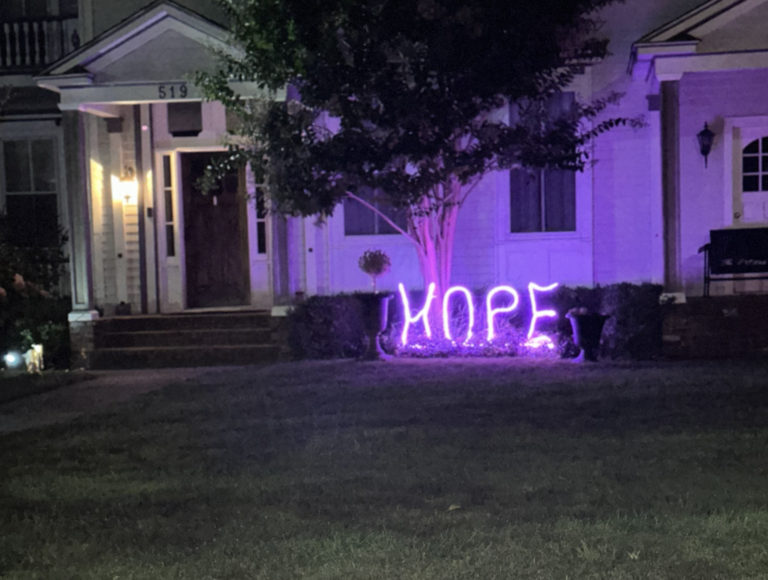
Something shifted inside me. It felt less like coincidence and more like permission—the universe telling me it was okay to believe things would work out.
I still carried the familiar weight of worry, doubt, and anxiety, but for the first time in months, those feelings weren’t the only ones in the room. Hope began to coexist with fear and I could breathe a little easier.
With that small but meaningful shift, I finally found myself able to start preparing for her arrival—not with certainty, but with openness. For the first time I allowed myself to imagine a future that didn’t feel so fragile.
The next morning, my friend gently encouraged me to buy just one item for my baby. She reminded me of the HOPE sign and that it was my birthday—that I deserved a moment of joy. With my heart racing and palms sweating, I finally made my first purchase for my daughter on July 23, 2024. When the cashier asked if it was a gift, I said yes. It was a gift to myself—the first time in years I allowed myself to feel joy and hope. It was the day I finally let myself believe I was going to be a mom.
Even After Birth, the System Didn’t Recognize Me as Her Mother
Unfortunately, belief alone wasn’t enough to make the system recognize me as one. Shortly after delivery, a doctor walked into our hospital room and exclaimed, “Oh my goodness, you look absolutely fabulous for having just given birth!” I had to respond, “Well… that’s because I didn’t.” It was a small moment, but it carried the weight of everything I had felt throughout this journey—the assumption, the erasure, the failure to see me unless I fit a familiar narrative.
That same disconnect appeared in places I never expected—places that should have made me feel grounded, validated and secure as a new mother. The sign on the hospital bassinet referred to our daughter as “Baby X,” using a name that wasn’t hers and wasn’t ours. Even the administrative details of her birth reinforced that disconnect. The initial birth certificate had to list our surrogate as the mother and her husband as the father. Only after submitting that paperwork—along with court orders—could the records department amend it to reflect my husband and me as our daughter’s legal parents and seal the incorrect version.
It took three to four months before we finally received her corrected birth certificate. In the meantime, we faced a cascade of complications, including delays in adding her to our health insurance. Even after she was born, even after she was in my arms, there were systems that still didn’t recognize me as her mother.
Surrogacy Is Not Just a Transaction
Before this journey, I’d absorbed the quiet assumption that surrogacy was transactional, clinical or somehow emotionally distant. Living it shattered that narrative entirely. Our angel surrogate is not someone I pity or look down upon—quite the opposite. She is a woman I admire, respect, praise, and, to my core, truly love. More than a year after our daughter’s birth, she remains an important part of our daily lives—someone I now consider a best friend and one of my closest confidants.
Is surrogacy a business arrangement? In some ways, yes. But it is also something far deeper. It is humanity revealing its truest, most generous form. It is proof that there are extraordinary people willing to use their own bodies—yes, with compensation—to give families the greatest gift imaginable: a child.
Paying it Forward
To this day, I have made a conscious effort to pay it forward—helping other intended parents navigate the surrogacy process and reminding them that they, too, deserve a solid support system.
In today’s society—especially in the age of social media—women are judged constantly. By friends, co-workers, family members, peers, and even our own reflections. We face judgment, unsolicited advice and constant questions—often from people who have never struggled to build a family. Many intended mothers feel torn about whether to share their news, host a baby shower, or take maternity photos. Even the decision to have one child or more becomes public, because surrogacy is rarely a private journey.
Women already carry an impossible amount of pressure to feel “good enough,” and to shame a woman for how her family is created is not only cruel—it’s unacceptable. The stigma surrounding surrogacy must change.
Most women who turn to surrogacy have already endured years of heartbreak, loss, and medical challenges. Instead of judgment, we should be celebrating the incredible advances in science that make it possible for people to have biological children when their own bodies have made that journey impossible. Surrogacy is not a luxury. It is not a vanity project. It is not reserved for the wealthy or the famous. It is a lifeline.
My intention in sharing this story is to raise awareness, shift the narrative, and honor the reality of surrogacy—not the polished version often portrayed in headlines, but the deeply emotional, complicated, and profoundly meaningful experience it truly is. So many families exist because of this process, and their stories deserve to be seen with compassion and respect.
Our daughter is our miracle. Despite my naturally pessimistic tendencies and the many hurdles we faced along the way, this journey led us exactly where we were meant to be—to the moment when I finally got to hold her in my arms and, without hesitation or apology, proudly and fully call myself a mother.