
Sponsored advertising content: The Mother Chapter received compensation from Tubby Todd to create this article. All opinions and product experiences are our own. We may also earn a commission from purchases made through links in this article.
Most moms don’t think they need a full step-by-step guide for how to apply sunscreen to a toddler—that is, until they’ve actually attempted to do it.
As a mom of three, I have only just recently felt like I’ve mastered it. I’ve always known how important it is to apply sunscreen on my kids, but knowing what you’re supposed to do and successfully doing it on three tiny moving targets are two very different things.
There’s the sunscreen routine that exists in theory: Apply it before leaving the house, cover every exposed inch and reapply it every two hours. Then, there’s the one that happens IRL—trying to rub lotion into a moving arm while someone asks for a snack. You’ll probably remember you forgot the back of your toddler’s neck halfway through the drive.
What finally made sunscreen stop feeling like such a production was actually pretty simple—it was creating a repeatable routine and using different types of sunscreen for different parts of the job.
Here’s the exact system that now works for us.
The Easiest Kids’ Sunscreen Routine, at a Glance
Apply a broad-spectrum, water-resistant sunscreen before your child gets dressed, using lotion for the initial application to all exposed skin. Keep a sunscreen stick nearby for the face, ears and quick touch-ups. Apply sunscreen 15 to 30 minutes before going outdoors and reapply it at least every two hours, as well as after swimming, sweating or towel-drying.
Starting before your child is fully dressed makes it easier to cover the areas around swimsuit straps, sleeves, waistbands and necklines that tend to get missed as kids wiggle and clothing shifts.
Can Babies Wear Sunscreen?
Babies younger than 6 months should primarily be protected from the sun with shade, lightweight clothing that covers the arms and legs and a wide-brimmed hat. The FDA recommends consulting a healthcare professional before applying sunscreen to an infant younger than 6 months.
For babies and children 6 months and older, apply sunscreen to any skin that is not covered by protective clothing. The American Academy of Dermatology recommends mineral sunscreens containing zinc oxide or titanium dioxide for the sensitive skin of babies and toddlers.
What to Look for in a Kid-Friendly Sunscreen
One of the biggest shifts in making the sunscreen application on my tiny, demanding bosses 10x easier was realizing that it wasn’t just the logistics—it was the product itself.
Parenting is already hard enough (especially with three kids), and anything that’s even slightly difficult to use, uncomfortable on their skin or disruptive to the rhythm of our day immediately creates friction. And friction, in moments like getting out the door or wrangling kids into the sun, is almost impossible to win against.
I knew the basics. The American Academy of Pediatrics (AAP) recommends mineral-based sunscreens for kids as the safest option, helping prevent sunburn while minimizing exposure to certain chemicals found in other formulas. As Brendan Camp, M.D., a Manhattan-based dermatologist at MDCS Dermatology, explains: “Mineral sunscreens, such as titanium and zinc, sit on the top layer of skin instead of being absorbed into it and are thought to be less likely to cause skin irritation in those with sensitive skin than organic or chemical sunscreens.”
Read: The Best Mineral Sunscreens That Don’t Leave a White Cast (Tested by a Mom of 3)
But here’s where things tend to fall apart in real life: most mineral sunscreens are thick, sticky, and notoriously hard to rub in—and kids notice that immediately. And once they notice, it’s game over. They squirm, they complain, they suddenly can’t stand still for more than two seconds, and what should be a quick, protective step turns into a full-blown standoff before you’ve even made it out the door.
That’s why, over time, I realized that the feel of a sunscreen matters just as much as the ingredients. Yes, I want something mineral-based and dermatologist-approved, but I also need it to glide on easily, absorb without a fight and not leave my kids looking (or feeling) like they’ve been coated in white paste.
The sweet spot is a formula that checks both boxes: safe and actually usable in real life, lightweight, non-sticky and easy to blend—ideally one that disappears quickly so there’s nothing for them to fuss over. Bonus points if it comes in a format that makes application faster (think sticks for faces, lotions that spread easily, or even well-formulated sprays for older kids when appropriate).
The Sunscreen Routine That Actually Works (Our Current Go-To)
Everything about my sunscreen routine changed when I found the right product—and for us that was Tubby Todd’s Sun Duo,. which includes both their mineral sunscreen lotion and sunstick (you can shop each one individually here: Tubby Todd Mineral Sunscreen SPF 50 and Tubby Todd Mineral Sunstick Broad Spectrum SPF 30). Together, these two products cover pretty much every scenario I find myself in throughout the day. If you’re not someone who wants to buy a set, you can also grab each one individually depending on how you actually use sunscreen day to day.
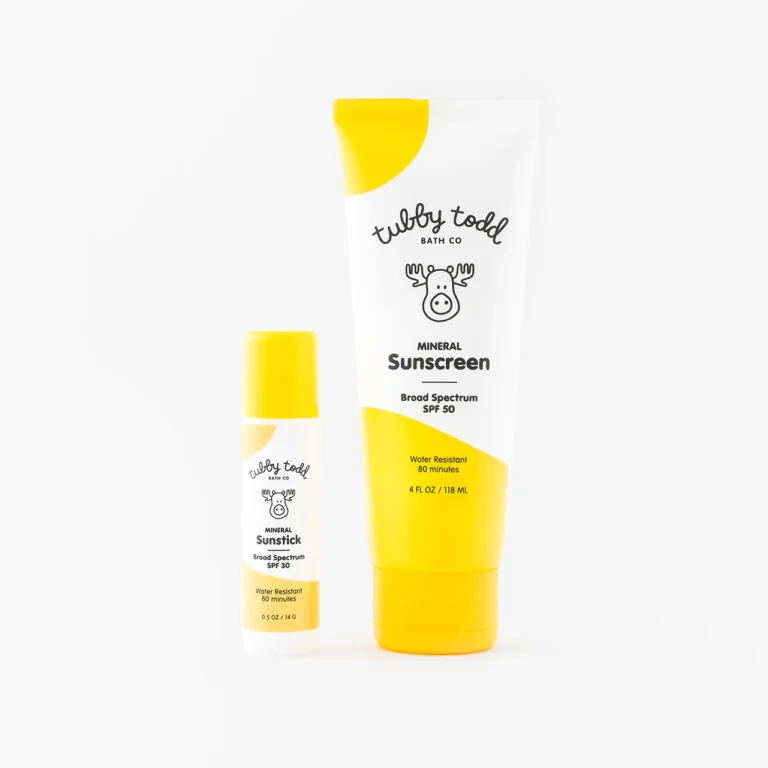
I’d be lying if I said it made my kids fall in love with using sunscreen (they’re still not fans), and the mornings haven’t become magically calm, but because these products simplify something that had always felt so much more complicated than it needed to be, I am forever grateful and a lifetime customer.
What I love most is that it feels like it was actually made with real parents in mind—not just what looks good on a label, but what works when you’re trying to get three kids out the door. The formulas are mineral-based (I mostly use their mineral sunscreen lotion for full-body application), but they actually go on easily and blend without that thick, chalky cast. They also feel hydrating on their skin thanks to ingredients like shea butter and coconut oil—not dry or tight like so many others I’ve tried.
That hydration piece is something I didn’t fully appreciate until I started paying closer attention to ingredients. As dermatologist Dr. Camp explains, “Some sunscreens include ingredients like hyaluronic acid, shea butter, vitamin E, and niacinamide. Hyaluronic acid is a humectant, meaning it helps moisturize skin by helping it retain water molecules. Shea butter helps hydrate skin by preventing it from drying out. Vitamin E is an antioxidant that can help protect skin from the damaging effects of prolonged sun exposure. Niacinamide is a calming agent that reduces redness, swelling, and inflammation.” And that’s exactly how this one feels—it’s not just protecting their skin, it’s supporting it.
Then there’s the part that matters just as much: my kids don’t immediately try to wipe it off because it doesn’t feel sticky or heavy and it doesn’t turn into a full-body resistance situation the second I start applying it. The sunstick is equally helpful—it glides on smoothly (no dragging across their face or tugging at their skin), and the texture feels more like skincare than sunscreen, which makes it so much easier to use on the go.
Read: 15 Skincare Products Dermatologist Moms Actually Use (And Recommend)
I think the best way to explain it is that it removes all the little points of friction that used to make sunscreen feel hard—the blending, the texture, the complaints, the time it takes—and replaces them with something that just fits. It’s one of the only sunscreens I’ve used where I’m not bracing myself for the application process, and that shift—from something I dread to something that just seamlessly folds into our routine—is the reason I keep reaching for it every single day.
A Few Sunscreen Tricks That Have Actually Made This Easier
Even with the best routine and products, I’ve learned that sometimes it’s the smallest shifts that make the biggest difference in whether something actually sticks. These are a few things that have genuinely made sunscreen application feel less like a daily battle in our house:
Keep your sunscreen in a cooler (or even just chilled).
This was a tip I picked up from Boston-based dermatologist Dr. Papri Sarkar, and it’s one of those things that sounds small but changes everything. Not only does storing sunscreen in a cooler help maintain the integrity of the ingredients (especially on hot beach or pool days) but applying something cool to your kids’ skin is surprisingly refreshing. Think about it: if you knew sunscreen would actually cool you down on a hot day, how much less would you dread it? The same goes for kids. That temperature shift alone makes them more willing to stand still for those extra few seconds, which, as any parent knows, is half the battle.
Tie it to something you already reach for.
Another tip from Dr. Sarkar that I immediately loved: take something you grab all the time (like a hair tie) and wrap it around your sunscreen bottle. It sounds almost too simple, but it works because the hardest part isn’t always the application, it’s the remembering. And when sunscreen is physically connected to something that’s already part of your routine, it becomes a visual cue you can’t really ignore. It’s one of those tiny, practical tricks that makes consistency feel a lot more automatic.
Apply before you’re “supposed to.”
We all know the recommendation—apply sunscreen 15–20 minutes before sun exposure—but in real life, that timing doesn’t always line up perfectly. What’s helped me is just building it into getting ready, period. Before shoes, before snacks, before we’re halfway out the door. Doing it earlier, when things are calmer (or at least calmer-ish), makes the whole process feel less rushed and more manageable.
Make the stick their job.
This has been one of the biggest unexpected wins for us. Giving my oldest the sunscreen stick and letting her apply it herself—on her face, her arms, even helping with her siblings—completely changes the dynamic. It turns sunscreen from something I’m enforcing into something she feels part of, and that small sense of ownership goes a long way.
Don’t aim for perfect—aim for consistent.
This one took me the longest to accept. There were so many days where I felt like if I didn’t do it exactly right—full coverage, perfectly timed reapplication—it somehow didn’t count. But the reality is, consistency matters more than perfection. Getting it on in the morning, doing quick touch-ups when you can, reapplying in a way that fits your day—that’s what actually protects their skin long-term.
Match the format to the moment.
This is where the routine really comes together. Lotion at home, when things are (relatively) controlled. I like to use Tubby Todd’s sunstick for quick, targeted touch-ups, especially when we’re on the go, and their mist for those chaotic, in-the-middle-of-everything reapplications. Once I stopped trying to force one product to do everything, the whole process became so much easier—and something I could actually keep up with.
Frequently Asked Questions
How often should you reapply sunscreen on kids?
In a perfect world, sunscreen gets reapplied every two hours, and even sooner if your kids are swimming, sweating or basically doing anything that involves water (which is… most things in the summer). In real life, I think about it more in rhythms than exact timing. Morning application before we leave the house, then a reset once we’ve been outside for a while—especially if we’re at the park, beach, or pool. The biggest shift for me was letting go of the idea that it has to be perfectly timed and focusing instead on staying consistent throughout the day. If you’re thinking about it and doing your best to reapply when it makes sense, you’re already ahead.
What type of sunscreen is best for babies?
After years of interviewing dermatologists, this is one of the few things that’s always been consistent: mineral sunscreen—specifically zinc oxide—is typically the go-to for babies and young kids. It sits on top of the skin rather than being absorbed, which tends to be gentler, especially for sensitive or still-developing skin. But I’ll be honest—the type matters, but so does how it actually feels, because if it’s thick, chalky, or hard to apply, you’re not going to use it as consistently as you should. The best sunscreen for babies is one that checks both boxes: safe and something you can realistically apply every single day without it turning into a whole situation.
What’s the easiest way to apply sunscreen to a toddler?
The honest answer? You don’t make it easier by trying harder—you make it easier by making it faster. What’s worked for me is breaking it into steps that fit into the day. Lotion at home before we leave (when things are slightly more controlled), a stick for quick face touch-ups when we’re out, and a spray or mist for reapplying when they’re already mid-play and not about to stop what they’re doing. Trying to do a full, perfect application every single time just isn’t realistic with toddlers. But having a system that works with their energy (not against it) makes a huge difference.
Can you use spray sunscreen on babies?
Sprays can definitely be helpful—especially for reapplication—but they’re not something I rely on for that initial, full coverage on my younger kids. When I do use them, I’m intentional about it. I’ll spray and then quickly rub it in to make sure everything is evenly covered and nothing gets missed. They’re great for those chaotic moments—like when everyone’s wet, sandy, and running in different directions—but I still like having a more controlled base layer underneath from earlier in the day. Think of sprays as a tool to help you stay consistent, not the only step in the process.